
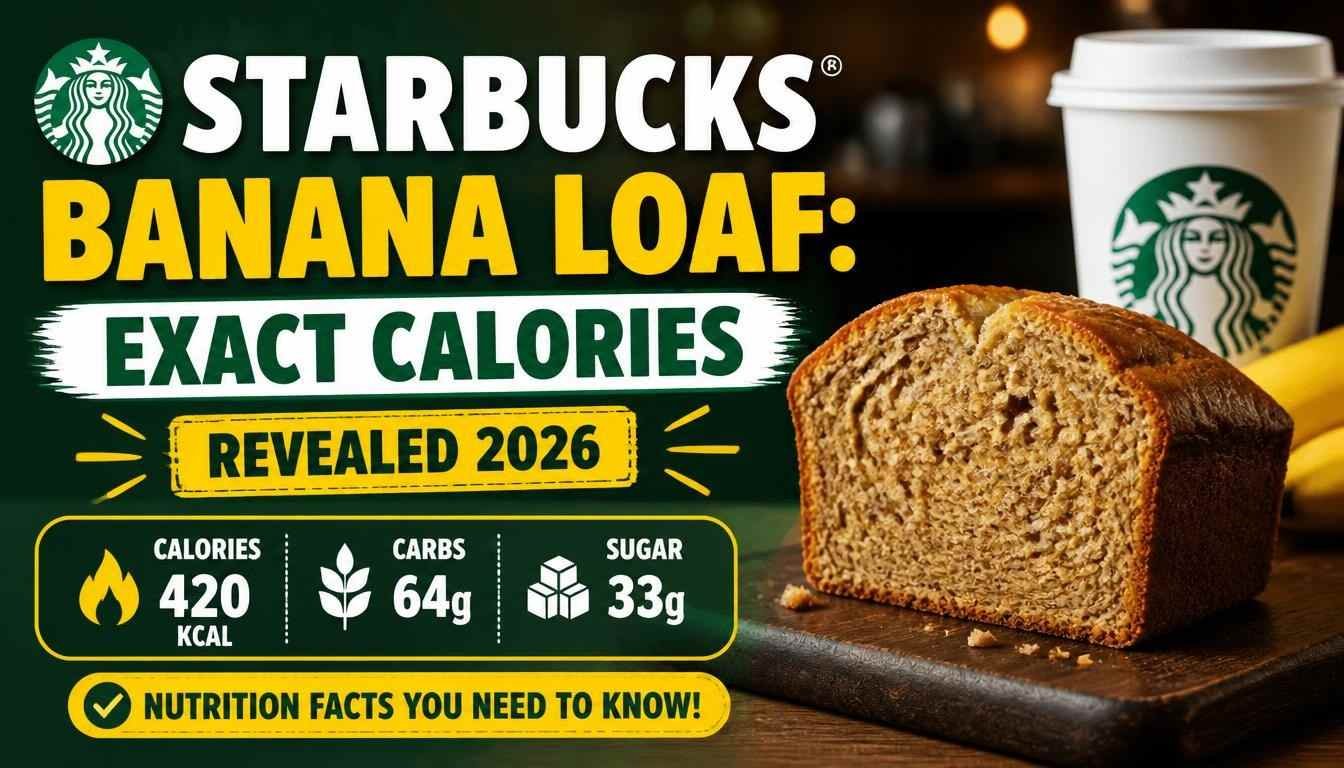
Calories in Starbucks Banana Loaf
A slice of Starbucks Banana, Walnut & Pecan Loaf delivers 380 calories, along with 20 grams of fat, 46 grams of carbohydrates, and 6 grams of protein. That single number raises a few practical questions: how those calories break down, whether the plain Banana Loaf differs, and where the item fits among other Starbucks bakery choices.
This page answers those questions with verified nutrition details, a full macronutrient breakdown, and a side-by-side comparison of the two banana loaf varieties. It also covers ingredients, common allergens, daily calorie context, and current menu availability, so you can check the facts that matter most to you before ordering.
Because recipes and regional menus can change, the figures here reflect published Starbucks nutrition data and are best confirmed through the official app or your local store. The sections ahead start with the calorie count itself and build from there.
Table of Contents
How Many Calories Are in a Starbucks Banana Loaf?
A standard slice of Starbucks Banana Loaf contains approximately 360 calories. This applies to the classic Banana Loaf sold at Starbucks locations, with a serving size of roughly 115 grams. The loaf is a dense, moist bakery item, so its calorie count reflects a substantial portion rather than a light snack.
The table below summarizes the key nutrition values for this banana loaf:
| Nutrient | Amount |
| Calories | 360 |
| Total Fat | 17g |
| Saturated Fat | 2.5g |
| Carbohydrates | 49g |
| Dietary Fiber | 2g |
| Total Sugars | 28g |
| Protein | 5g |
| Sodium | 320mg |
| Cholesterol | 70mg |
The 360 calories come primarily from carbohydrates and fat, with 49 grams of carbs and 17 grams of fat per slice. Protein content is modest at 5 grams, while sugars total 28 grams. Keep in mind that Starbucks offers seasonal variations, such as the Banana Walnut & Pecan Loaf, which contains 410 calories per slice. Nutrition values can vary by region and recipe updates.
What Is the Serving Size?
A serving of Starbucks Banana Loaf is one slice, weighing approximately 115 grams (about 4 ounces). This is the reference amount used for all calorie and nutrition values, meaning the 360 calories listed apply to that single slice—not the entire loaf.
The distinction matters because the loaf is sold as one piece, yet the nutrition information is calculated per serving. If you eat the whole loaf, you consume the full calorie and nutrient totals shown. Starbucks nutrition data reflects standard recipes, so weights and values can vary slightly by location and preparation.
Starbucks Banana Loaf: Full Nutrition Facts
The table below provides the complete nutrition breakdown for a standard slice of Starbucks Banana Loaf (115g), including macronutrients and their respective % Daily Values based on a 2,000-calorie diet.
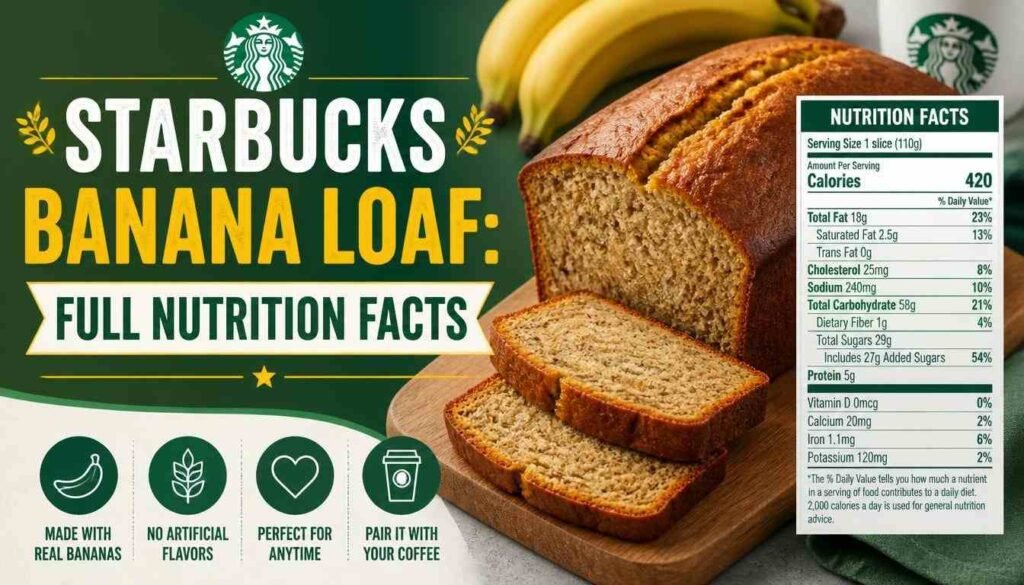
| Nutrient | Amount | % Daily Value |
| Calories | 360 | — |
| Total Fat | 17g | 22% |
| Saturated Fat | 2.5g | 13% |
| Trans Fat | 0.3g | — |
| Cholesterol | 70mg | 23% |
| Sodium | 320mg | 14% |
| Total Carbohydrates | 49g | 18% |
| Dietary Fiber | 2g | 7% |
| Total Sugars | 28g | — |
| Protein | 5g | 10% |
The % Daily Value column shows how much each nutrient contributes to a standard 2,000-calorie daily diet. For example, one slice provides 22% of the daily value for total fat and 18% of the daily value for carbohydrates, while contributing 10% of the daily protein recommendation. Keep in mind that Starbucks also offers a Banana, Walnut & Pecan Loaf variation, which contains 380 calories with 20g total fat, 46g carbohydrates, and 6g protein per 113g serving. Nutrition values may vary by region and recipe updates.
Sugar, Fat, and Sodium Breakdown
A standard slice of Starbucks Banana Loaf contains 28g of total sugars, 17g of total fat, and 320mg of sodium. These three values are the most relevant for anyone tracking daily limits, since each one contributes a meaningful share of a typical 2,000-calorie reference diet.
The 28g of sugar represents the loaf’s single largest nutrient concern, with no fiber or protein to significantly slow absorption. Fat content splits between 2.5g saturated and the remainder from unsaturated sources. Sodium at 320mg comes largely from the baking process and leavening agents rather than added salt. Values shift slightly with recipe updates or regional variations.
Banana Loaf vs. Banana Walnut and Pecan Loaf: Are They the Same?
No, these are two different products. The standard Starbucks Banana Loaf contains 360 calories per 115g slice, while the Banana, Walnut & Pecan Loaf has 380 calories per 113g slice. The key difference is the nuts: walnuts and pecans are mixed into the batter and scattered on top of the nut version, adding fat and protein.
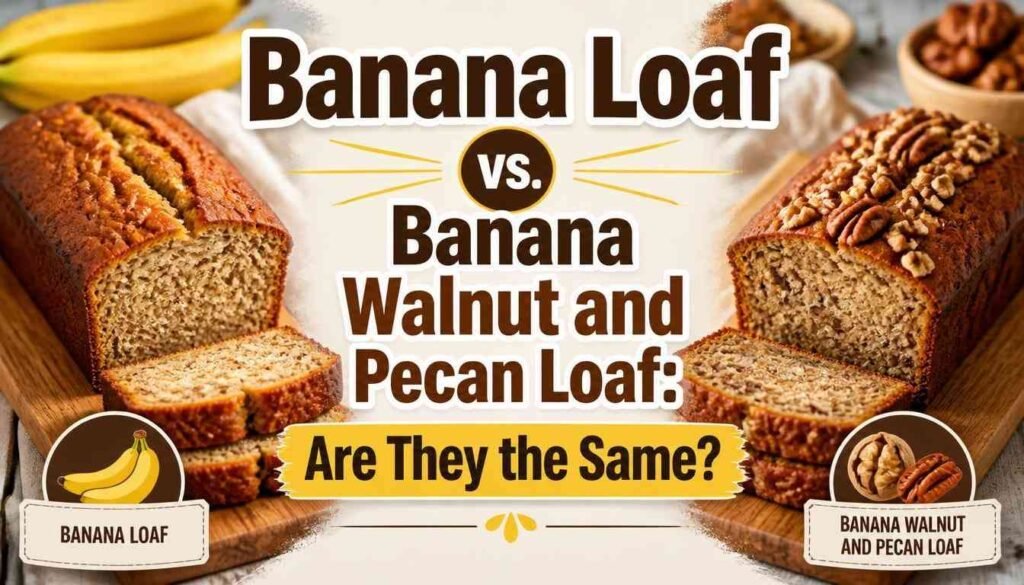
The base recipes are similar in structure—both are dense, moist banana breads—but the addition of nuts changes the nutrition profile. The walnut and pecan loaf has 20g total fat and 6g protein, compared to 17g fat and 5g protein in the plain version.
| Feature | Banana Loaf | Banana Walnut & Pecan Loaf |
| Calories | 360 | 380 |
| Serving Size | 115g | 113g |
| Total Fat | 17g | 20g |
| Protein | 5g | 6g |
| Sugars | 28g | 26g |
| Sodium | 320mg | 300mg |
Nutrition values may vary by region and recipe updates. Availability also differs—some locations carry only one version or rotate them seasonally.
How the Starbucks Banana Loaf Compares to Other Starbucks Bakery Items
At 360 calories per slice, the Banana Loaf sits in the middle of Starbucks’ bakery range—lighter than the Coffee Cake (440 calories) and Iced Lemon Loaf (410 calories), but heavier than the Butter Croissant (280 calories) and Cheese Danish (290 calories).
The table below compares calorie counts across popular Starbucks bakery items to support your purchase decision:
| Bakery Item | Calories | Serving Size |
| Butter Croissant | 280 | 75g |
| Cheese Danish | 290 | 80g |
| Banana Loaf | 360 | 115g |
| Banana Walnut & Pecan Loaf | 380 | 113g |
| Pumpkin Loaf | 390 | 121g |
| Iced Lemon Loaf | 410 | 115g |
| Coffee Cake | 440 | 113g |
| Cinnamon Roll | 480 | 152g |
The Banana Loaf offers a moderate calorie position with a dense, moist texture. If you want a lighter option, the Butter Croissant provides the lowest calorie count among these items. For those seeking more protein or texture, the Banana Walnut & Pecan Loaf adds nuts but also 20 more calories.
Starbucks Banana Loaf Ingredients and Allergens
The Starbucks Banana, Walnut & Pecan Loaf is made with bananas, enriched wheat flour, sugar, soybean and/or canola oil, eggs, walnuts, and pecans. The full ingredient list also includes mono and diglycerides, sea salt, sodium bicarbonate, baking powder, natural flavor, spice, and soy lecithin.
For allergy awareness, this loaf contains the following allergens:
- Egg
- Pecans
- Soy
- Walnuts
- Wheat
The standard Banana Loaf without nuts contains egg, soy, and wheat. Starbucks advises customers to check allergen information regularly, as recipes may change, and cross-contact is possible in stores due to shared equipment. If you have a tree nut allergy, the Banana, Walnut & Pecan Loaf is not suitable. For the most current allergen details, ask your barista or check the official Starbucks allergen guide for your region
Common Allergens in the Starbucks Banana Loaf
The Starbucks Banana Loaf contains three major allergens: wheat, egg, and soy. The Banana, Walnut & Pecan Loaf version adds tree nuts—specifically walnuts and pecans—bringing the total to five declarable allergens.
Wheat comes from enriched flour, egg is used as a binder, and soy appears through soybean oil and soy lecithin. Anyone with a tree nut allergy should avoid the walnut and pecan variety entirely. Cross-contact is also possible because these items share display cases and preparation areas with other baked goods. Starbucks updates allergen information periodically, so check the official allergen guide or ask store staff before ordering if you have a severe allergy.
How the Starbucks Banana Loaf Fits Into Your Daily Calorie Goals
At 360 calories, one slice of Starbucks Banana Loaf uses roughly 18% of a standard 2,000-calorie daily intake. That leaves about 1,640 calories for other meals and snacks, so the loaf works best as a planned treat rather than an add-on to an already full day.
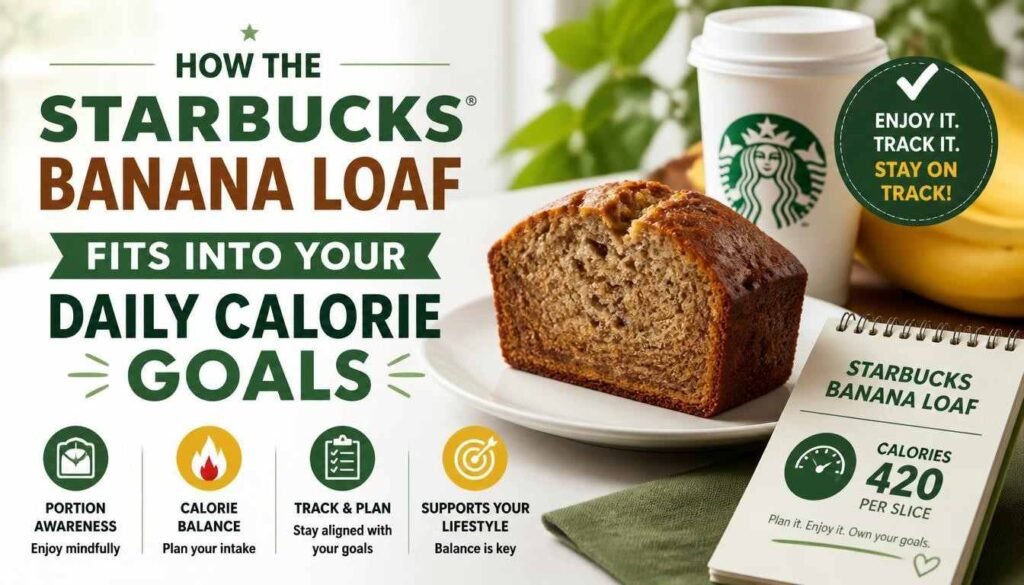
Where it fits depends on your individual target. Someone following a 1,500-calorie plan would spend 24% of the day’s calories on a single slice, while a 2,500-calorie plan leaves more room. Pairing the loaf with a black coffee keeps the total near 360 calories; adding a latte or frappuccino pushes it higher. For most people, treating the loaf as a breakfast or afternoon snack works better than eating it alongside a full meal. Checking your remaining calorie budget before ordering helps you decide whether to eat the whole slice or split it.
Is the Starbucks Banana Loaf Still on the Menu?
Yes, Starbucks currently offers the Banana, Walnut & Pecan Loaf as part of its permanent bakery lineup. According to the official Starbucks menu, this loaf remains a standard menu item in the United States. Note that this is the nut-containing version—the plain Banana Loaf without walnuts and pecans may not be available at all locations.
Availability can vary by region and store. Some locations may carry only one banana loaf variety, while others stock both. The loaf is typically found in the bakery case alongside other year-round items like the Iced Lemon Loaf and Cinnamon Coffee Cake. If you want to confirm before visiting, checking the Starbucks app for your specific store is the most reliable way to verify current availability.
Calculate Your Starbucks Calories
Use the calculator below to build your full Starbucks order and see the total calories, fat, carbohydrates, sugar, and protein in one place. Start by selecting your drink size, milk, syrups, and any bakery item, including the Banana Loaf. The tool pulls from current nutrition data so you can compare customizations side by side before you order.
This is especially useful when you want to know how a single change affects your total. Swapping whole milk for almond milk, removing a syrup pump, or adding a bakery item shifts the numbers in ways that are hard to estimate mentally. The calculator updates instantly, so you can adjust one variable at a time and see the difference. It covers drinks, food, and common customizations in one view, giving you a clear picture of how your order fits your daily goals before you reach the counter.
FAQ’s
How many calories are in a Starbucks Banana Loaf?
A standard slice of the Starbucks Banana, Walnut & Pecan Loaf contains 380 calories per 113g serving. The plain Banana Loaf version has 360 calories per 115g slice. Values may vary slightly by region and recipe updates.
How many carbs are in the Starbucks Banana Loaf?
A standard slice of the Starbucks Banana, Walnut & Pecan Loaf contains 46 grams of carbohydrates per 113g serving. This includes 2 grams of fiber and 26 grams of sugars. The plain Banana Loaf has 49 grams of carbs per slice.
Is the Starbucks Banana Loaf the same as the Banana Walnut and Pecan Loaf?
No, they are two different products. The Banana, Walnut & Pecan Loaf includes nuts mixed into the batter and on top, adding fat and protein. The plain Banana Loaf contains no nuts.
Does warming the Starbucks Banana Loaf change the calorie count?
No, warming does not change the calorie count. Heat may slightly alter texture and moisture, but the nutrition values remain the same as the unheated slice.
Is the Starbucks Banana Loaf available year-round?
The Banana, Walnut & Pecan Loaf is a core menu item, so it is generally available year-round at most U.S. locations. However, availability can vary by store and region, so checking the Starbucks app is the most reliable way to confirm.
Conclusion
The Starbucks Banana, Walnut & Pecan Loaf contains 380 calories per 113g slice, making it one of the more moderate options in the bakery case. Understanding the full nutrition picture—including fat, carbohydrates, sugars, and protein—helps you decide how it fits your day. The loaf’s ingredients and allergens also matter if you have dietary restrictions.
Nutrition values can shift with recipe updates and regional differences, so the numbers here are a useful starting point rather than a permanent record. Checking the official Starbucks app or asking store staff gives you the most current details, especially for allergen concerns. Use this guide to make an informed choice, and verify specifics before you order. And if you’d like to tally the loaf alongside your drink, our Starbucks Nutrition Calculator can total your whole order.
One Comment